

Greece was far from the headlines before the debt crisis broke out in the Eurozone in 2010, the same applies today to Japan, which, due to its massive debt and the slide of the yen, is applying to star in the largest economic and financial crisis human history will ever know.
The political career of the prime minister of Japan, Sanae Takaichi, is sinking almost as fast as the yen these days, and both developments are closely linked.
The yen has slid toward 164 against the dollar, to its weakest level since 1986, driven in part by the same economic pressures that are hitting Takaichi's approval ratings.
A new poll by Mainichi Shimbun shows that support for her cabinet dropped by 10 points to 41% in mid-July, falling below 50% for the first time.
However, the fall of the yen is concerning for three reasons that global markets have largely overlooked.
First, it reveals how much the ruling Liberal Democratic Party (LDP) lacks new strategies to keep pace with a faster-growing China.

A weak yen has been the primary growth engine for the LDP for 25 years.
And Takaichi's declining popularity compounds the problem, as she invests political capital in an unpopular Imperial House Law, which changes the rules governing both marriage and adoption within the royal family of Japan, instead of focusing on economic concerns.
Second, there is a strange silence from Washington as the yen records new modern lows.
Given the scale of the current trade war, Trump has just imposed new 10%-12.5% tariffs on most major trading partners, one would expect sharp criticism against Japan for manipulating its exchange rate.
Instead, the Department of the Treasury under Scott Bessent has said almost nothing about the yen.
Third, the yen no longer seems to attract demand as a safe haven that it once attracted amidst global turmoil.
This may reflect the broader strength of the dollar rather than the weakness of the yen, nor is gold recording an increase, but it may also confirm a fear long nurtured in Tokyo: that global capital is simply bypassing Japan.

The shadow of China and geopolitical pressures
For now, Tokyo's priority is propping up a slowing economy.
Japan is projected to grow by just 0.5% in 2026, far below the inflation trajectory signaled by the Bank of Japan (BOJ) for most of the year.
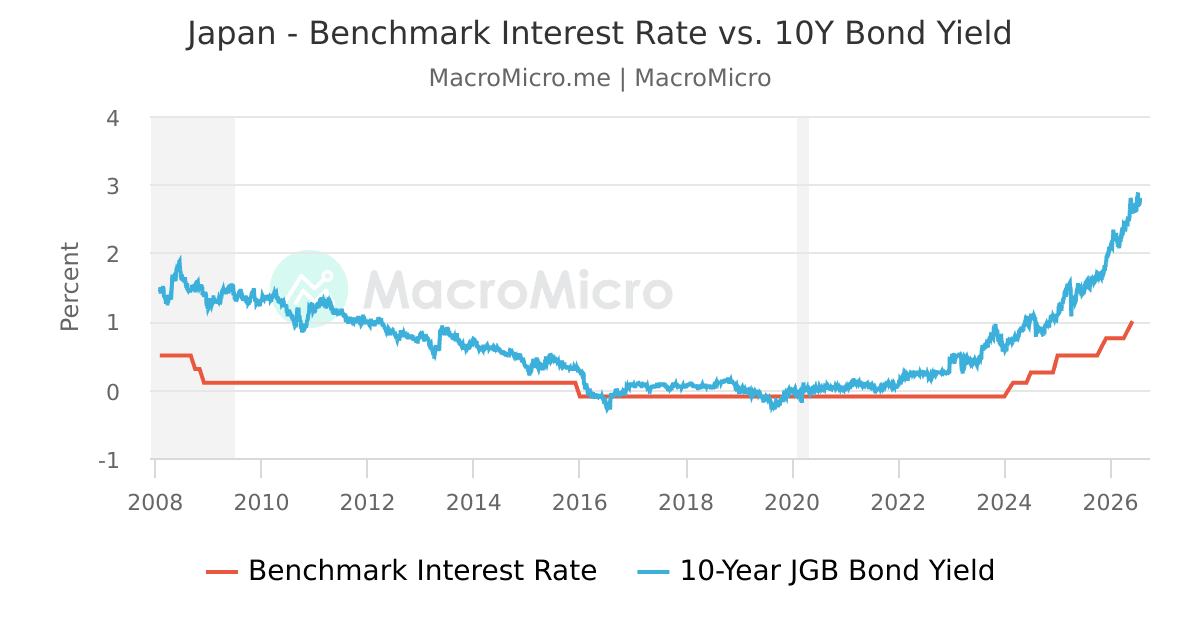
Since the BOJ raised interest rates to a 31-year high of 1% in mid-June, the war in Iran has emerged as a serious risk, threatening to push Japan (which depends on oil imports) into stagflation, a scenario that could prove even harder to manage than the deflation of previous decades.
Despite public statements and periodic intervention, the reality is that Takaichi's government still wants a weaker yen, not necessarily a plunge to 170/dollar, but a retreat to the 140-150 dollar range would increase pressure on Japan's $4.2 trillion economy.

The shadow of China looms heavy
Beijing spent the last two years exporting excess industrial production globally, intensifying price competition (in economic terms, deflation) that President Xi Jinping's government is struggling to tame.
A stronger yen would blunt Japan's ability to compete on price in export trade, which is also receiving a boost from the artificial intelligence (AI) boom.
The market capitalization of SoftBank Group has now surpassed that of Toyota, while companies like Kioxia and Taiyo Yuden are also steadily gaining ground.
Regardless of what Takaichi states publicly, she worries that a stronger yen could slow this momentum, along with the broader rally that pushed the Nikkei 225 index above 72,000 points last month (it has since eased back to around 64,000, after starting the year near 50,000).
The policy of interventions and the ghost of Takahashi
Nevertheless, officials express rhetorical fury over the currency's slide without doing much to address its root cause. Minister of Finance Satsuki Katayama continues to warn that she is ready for "decisive action" if the yen weakens excessively, and Tokyo indeed intervened in the foreign exchange market in April and May when the exchange rate crossed 160.


Yield curve control in bonds
But as Deutsche Bank strategist Mallika Sachdeva notes, without a credible plan to curb Japan's soaring debt, these moves are largely symbolic: if the fiscal situation becomes the dominant policy concern, currency management could increasingly give way to bond market yield curve management, and how the government handles this balance will shape the trajectory of the yen going forward.
That is why past interventions have not paid off this time, traders have watched this pattern repeat too often to expect a different outcome.
Tokyo still possesses levers of pressure, even if using them would be dangerous.
One path involves persuading US Treasury Secretary Scott Bessent to participate in a sustained, coordinated intervention.
The more radical option would be the revival of the reflationary strategy of Korekiyo Takahashi, the minister of finance often called the "Keynes of Japan", who combined aggressive monetary easing with fiscal expansion, including direct purchases of government debt by the central bank, to pull Japan out of the Great Depression in the 1930s.
Former Federal Reserve chairman Ben Bernanke has praised the approach, and many economists consider it a precursor to Modern Monetary Theory (MMT). Takaichi's mentor, Shinzo Abe, had followed Takahashi's example during his prime ministership in 2012-2020, pushing the BOJ toward massive quantitative easing (QE) starting in 2013.
By 2018, the BOJ's balance sheet had grown larger than the entire economy of Japan, a first among the G7 group.
However, even Abe stopped short of going all-in on Takahashi-style debt monetization.
The risks of monetary policy and warnings
Implementing such a policy now, in 2026, could easily backfire.
Twenty-seven years of near-zero interest rates and a weak yen never revived Japan's growth engine, if anything, they blunted the urgency of structural reforms.
The loss of competitive advantage
While Japan watched developments passively, China reshaped global manufacturing in the same way Japan itself did in the 1980s, and Japanese industry still has not found an answer to competitors like the electric vehicle giant BYD or the success of the AI model DeepSeek.
All this leaves the BOJ facing a precarious period as it tries to continue normalizing interest rates.
Moody’s Analytics economist Sarah Tan points out that inflation prospects now depend heavily on developments in the Middle East and their impact on commodity prices.
Tan says that if nominal wages fail to keep pace, real incomes and consumer spending could suffer a significant drop, with any further yen depreciation simply adding to imported inflation.
Takaichi's team appears to be drawing the wrong lessons from two eras of quantitative easing, the 2000s version and Takahashi's original 1930s model.
Modern quantitative easing (QE) dates back to 2001, when then BOJ governor Masaru Hayami used it to fight deflation and curb a non-performing loan crisis inherited from the 1990s.
The approach later spread to the US, Britain, the Eurozone, and Australia after the 2008 global financial crisis.
However, while these central banks eventually normalized their policy, Japan never fully weaned off monetary support. Despite years of tightening, the BOJ still holds more than half of total outstanding Japanese government bonds and remains the largest stock owner in the country.
Current governor Kazuo Ueda has moved further toward exiting zero rates this year than his predecessor Toshihiko Fukui managed between 2003 and 2008, when rates eventually returned to zero and quantitative easing returned by 2009.
Ueda's team is expected to leave rates unchanged on July 31. Long-term, however, he is determined not to repeat this cycle.
Ueda's biggest obstacle may be the LDP itself, which has relied essentially on one economic playbook, fiscal stimulus, for seven decades of nearly uninterrupted governance since 1955.
Even senior party officials now privately admit that a quarter-century of zero rates failed, with the prolonged fall of the yen being the price now being paid.
Takaichi, however, shows few signs of deviating from this tradition. Her economic approach so far appears almost indistinguishable from that of Abe, and by extension, from the Takahashi model that inspired him.

Political collapse: The risk of a "Liz Truss moment"
Tension peaked briefly this month when Takaichi's government hinted that the Government Pension Investment Fund (GPIF), the largest pension fund in the world, might repatriate large amounts of overseas capital, a move that would have strengthened the yen.
Tokyo has since backed down, fueling concern that officials will instead rely on the BOJ to resume bond purchases, a step that Sachdeva of Deutsche Bank warns "could prove to be a very negative development" if it appears that the central bank is colluding to support the bond market.
This is the core of the controversy.
Ueda entered 2026 looking like the governor who would finally lead Japan out of deflation, having raised the key interest rate to a 30-year high of 0.75% in December and to 1% last month.
But the war in Iran, which broke out on February 28, overturned those plans, sending oil prices and tariff pressures soaring just as the government reacts to further monetary policy tightening.
Takaichi has openly called additional rate hikes "stupid", and in March, lawmakers questioned her directly regarding whether she is exerting pressure on the BOJ.
While formally independent, the BOJ faces far greater political pressure than its peers like the Fed or the European Central Bank, making Takaichi's resistance to fighting inflation particularly striking, just as the price shocks caused by Iran threaten to destabilize the region's economy.
An unpredictable factor here is that, as China's growth slows, President Xi may very well turn to a weaker yuan to boost exports, using political cover from Tokyo's own currency devaluation efforts.
This would certainly draw the attention of Bessent in Washington.
Another is that bond markets are getting nervous.
As Robin Brooks, an economist at the Brookings Institution, notes, Takaichi seeks to end excessive fiscal austerity.
"This is extremely irresponsible," he points out, warning that Tokyo could star "in the initial stages of a global debt crisis."
Yields on long-term government bonds have risen sharply everywhere.
Markets are losing patience with governments that are chronically incapable or unwilling to reduce public debt.
It is no time to pretend that Japan's massive debt is not a problem.
Denial is not a plan."
Hence the fears of a "Liz Truss moment" in Tokyo.
In late 2022, then prime minister of Britain, Truss, destabilized the debt market by attempting to sneak unfunded tax cuts past bond traders, leading to her removal from the prime ministership.
The extreme market turmoil remains a cautionary tale for Takaichi as her party considers tax cuts.
With a debt-to-GDP ratio of 260% and the population aging rapidly, Takaichi must tread carefully.
This is not the first contact for global investors with "this time is different" rumors surrounding Asia's second-largest economy.
This means that anyone betting on a yen rally may regret it when the end of the year arrives, potentially opening the floodgates to a financial Armageddon.
www.bankingnews.gr











Σχόλια αναγνωστών